There are things we know about the people closest to us for years and almost never say to them.
We know why we love our parents. Why we respect a friend. What we admire in someone we have lived beside for decades. We remember the moment that changed how we saw them. The family stories told so many times they have worn smooth. The jokes that make no sense to anyone outside. Small details that, over time, become part of what that person means to us.
In ordinary life, almost none of this becomes words.
Not because we don't feel it. Because there is rarely a good moment for that kind of conversation.
You can know someone for twenty years and never tell them which quality of theirs you value most. You can understand exactly what your mother taught you and never once put it into a sentence for her. You can carry something your father did two decades ago, and have no idea he forgot it long ago.
We tell people remarkably little about how they look from the outside.
And sometimes that is the thing they most need to hear.
When we look for a gift, we are rarely looking for an object
This is probably why choosing a present for someone close is so difficult.
On the surface it is a simple task. A birthday is coming, or an anniversary, and something has to be bought.
But the closer the person, the worse the usual approach works.
Not because objects make bad gifts. Because we want the object to carry more than an object can hold.
To give your mother something that contains gratitude, not only congratulations.
To remind a friend how much you have been through together.
To tell someone you love not just that you love them, but why, and since when, and in which particular moments.
To show your parents that the stories they told for years did not disappear. That somebody was listening.
So you can spend an evening scrolling through things that are beautiful, useful and expensive, and still feel that none of them is it.
We think we are choosing an object. We are looking for a shape to put a feeling in.
The gifts that stay are rarely the expensive ones
Try to remember the presents you were given ten years ago.
We rarely remember what a gift cost. We remember the story attached to it.
Someone kept a letter.
Someone still has an old card tucked between the pages of a book.
Someone owns a perfectly ordinary object that cannot be thrown away, only because of who gave it and when.
Objects lose their newness. The meaning we attached to them can stay.
Maybe that is why a deeply personal gift says less about the taste of the person choosing it than about their attention.
I know you.
I remember.
I noticed.
It mattered to me that this should be kept.
There is often more closeness in that than in any beautifully phrased wish.
We are strangely certain we will remember
Memory has an inconvenient habit. While something is still fresh, forgetting it seems impossible.
This story will always be told.
Nobody could forget that thing the child said.
We will obviously remember how we met, where we went that summer, what we laughed about at the table, what our grandmother said when she was angry.
Then time passes.
The details go first. Then the dates blur. One story merges into another. One person remembers the beginning, someone else remembers the end.
And at some point you notice how fragile the things you assumed were permanent turned out to be.
Which is probably why writing something down matters.
Not because paper is better than memory. Because it helps memory stay.
A person is not a biography
When someone mentions a book about a person, we usually imagine a biography.
Born here. Studied there. Worked, married, moved.
But that is not how we know the people close to us.
We do not hold them as a sequence of dates.
We know a character.
We know the way they react. Their turns of phrase. Their small weaknesses. The decision that once surprised everyone. The story that explains who they are better than any list of qualities.
Sometimes a single episode says more about a person than several pages of facts.
And those are exactly the things worth seeing gathered in one place.
Not a life arranged by year.
A person as the people around them actually know them.
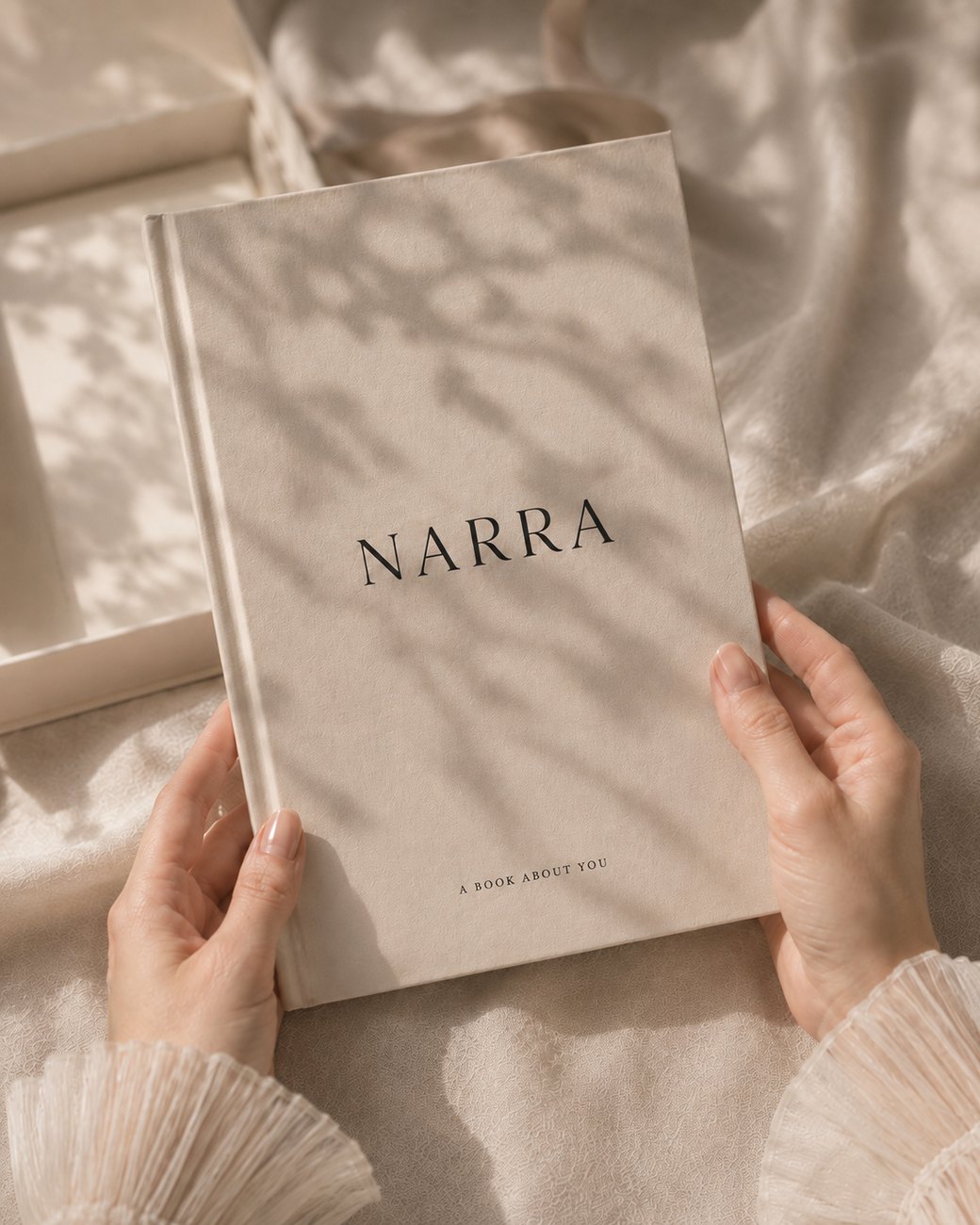
This is where NARRA came from
NARRA is built on a simple idea: to keep what usually exists only between people.
When someone orders a personal book for a person close to them, we start by listening.
We ask them to talk about that person. About character. About the memories that matter. About the funny episodes. About what makes them different from everyone else. What their friends or family love most in them. Which moments are worth keeping.
The book grows out of those conversations.
Not a biography, and not an album of photographs.
A book about that particular person, told through the memories of the people who know them.
Photographs become watercolour illustrations. Individual stories become chapters. The person giving the book can include their own words at the end.
And at some point, the person opens the book and finds themselves in it.
Not the official version. Not a list of achievements.
The version of themselves that lives in other people's memories.
Perhaps the most valuable part is not the book itself, but the chance to finally hear something that ordinary life might never have said out loud.
Sometimes the search should start with a different question
When we think about what to give a mother, a father, a close friend, a partner, or someone who already seems to have everything, the first instinct is understandable. Open a search and look at options.
But something else can come first.
Think about the person.
What do you value most in them?
Which moment with them do you still remember clearly?
What have you never thanked them for?
Which quality have you been noticing for years?
What do only the closest people know about them?
And what would you want kept, so that it does not disappear in ten, twenty or thirty years?
After those questions, the right gift is often much easier to see.
Because the most personal gifts do not begin with an object.
They begin with a person.